Philadelphia: Three Centuries of Planning

From its founding by William Penn, planning has played an integral role in the growth and development of the City. This overview of key highlights in Philadelphia's planning history can provide important lessons and stimulate ideas for the future direction of our City and its neighborhoods.
1683 - A "Greene Countrie Towne:" Planning for a New City
Philadelphia's planning history began with William Penn's vision for a New World settlement that offered its residents religious freedom and economic opportunity. The new city was framed by the Delaware and Schuylkill Rivers. Between the rivers, a rectangular street grid was bisected by two major, intersecting thoroughfares: north-south Broad Street, and east-west High (now Market) Street. The resulting quadrants each contained a public square, now known as Franklin Square, Washington Square, Rittenhouse Square and Logan Circle. The central square, at the intersection of the two primary streets was reserved for civic buildings. And, City Hall now sits on this center square. Penn's plan has endured the test of time. In 2007, Center City looks almost exactly like the original 1683 plan.
1812-1868 - "Faire Mount:" Planning for Clean Water and Open Space

The City's park system actually started as a public works project to protect the drinking water supply. In 1812, land was purchased on Faire Mount (the present site of the Philadelphia Museum of Art) for the Water Works. Surrounding lands were acquired in 1828 to further protect the water supply. In 1855, the Lemon Hill estate was dedicated as a public park. The need for a city agency to manage the growing amount of parkland led to the creation of the Fairmount Park Commission in 1867. The park grew quickly. In 1868, 1,800 acres in the Wissahickon Valley was added to the park system. Today, the citywide Fairmount Park system comprises 9,200 acres.
1903-1937 - The Parkway: Planning Against the Street Grid
Today, the diagonal boulevard connecting City Hall to the Art Museum may seem only logical. But, it took decades before these two prominent public buildings were connected. Beginning with the construction of City Hall in the 1870s, many individuals recommended creating this radial street. However, a plan for the Parkway was not officially created until 1903. The initial plan was significantly revised to include a grander style of boulevard, complete with a landscaping plan and proposed sites for museums, art schools, and the Free Library. Construction began in 1917, and was completed in 1926. It was named the Benjamin Franklin Parkway in 1937.

1919-1942 - Planning Becomes a City Chartered Agency with Professional Staff
In the 1920s and 1930s, Philadelphia's economy was booming. Immigrants poured into the city. The population grew to nearly two million. This population and economic growth resulted in major transportation projects - such as the Delaware River Bridge and expansion of the subway. New buildings like the Suburban Station office building, Penn Mutual Life, and the PSFS Building were just a few of the many new buildings from this era. As the City grew, planning became increasingly important. In 1919, the new City Charter called for a City Planning Commission and a City Zoning Commission. And, the City Planning Department was created in 1942. Its first director was Robert Mitchell, a transportation planner.
1947 - The Better Philadelphia Exhibition: Planning for the City's Future
In 1947, the Better Philadelphia Exhibition opened. This exhibit was housed in Gimbel's Department Store at 9th and Market Streets. Over the course of two months, it attracted more than 340,000 people. The showcase of the exhibit was a large model of Center City as it presently looked with 13 sections that rotated to display a model of how Center City could look by the year 1982 (the City's 300th birthday).
Robert Mitchell, the City's planning director, Edmund Bacon, Louis Kahn, and several leading architects and urban planners from the era prepared this exhibit in order to educate the public about the role and importance of city planning and what it could achieve. The exhibit sparked citizens' interest in planning not only for Center City, but also in planning for their own neighborhoods.
Ed Bacon would later become the executive director of the City Planning Commission, serving as a dynamic visionary from 1949 to 1970. During his tenure, the Commission conceived and implemented major projects that dramatically transformed the City, including the revitalization of Society Hill and the plan for the far Northeast.

1980s - Planning and the Debate Over William Penn's Hat

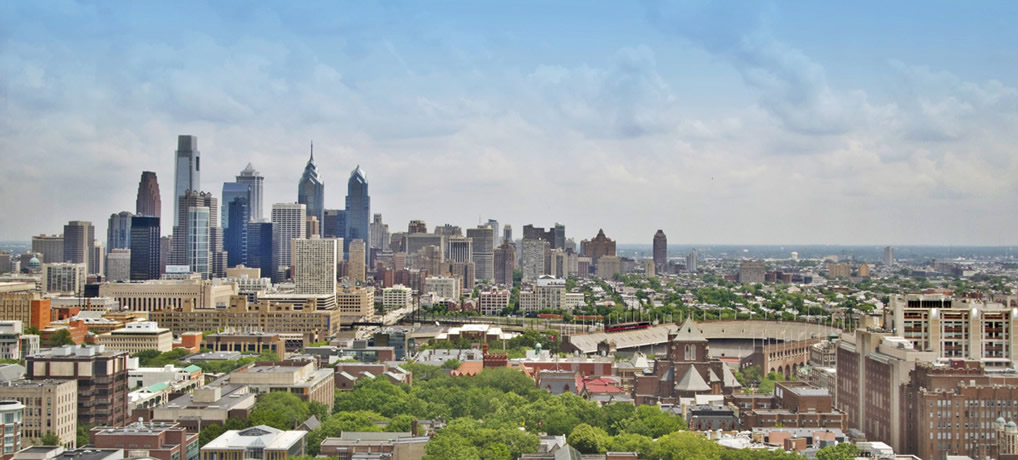
For decades, there was a "gentleman's agreement" that buildings in the downtown should be no higher than the statue of William Penn on top of City Hall Tower. In 1984, developer Willard Rouse proposed an office building that would exceed this self-imposed height limit. The desire to break this barrier led to a spirited public debate. In 1987, One Liberty Place was built topping out at 960 feet - towering over the 491-foot City Hall.
However, the concerns about tall skyscrapers and their impact on existing buildings and the residential neighborhoods within Center City, spurred the City Planning Commission to develop a new Plan for Center City. The plan was released in 1988 and it sought to balance growth with neighborhood preservation. To help implement the plan's goal, new zoning classifications were created for high-rise office and residential buildings. These new zoning laws were developed over several years of intense work with extensive public involvement. Thus, the One Liberty Place controversy led to the creation of a modern set of zoning regulations for Center City that are a reflection of Philadelphia's civic values in terms of building scale, livability, historic preservation, enhancement of public transportation, and the creation of safe, inviting and active sidewalks and public spaces.
2008 and beyond - Planning for What Will Happen Next

What will be the next chapter in Philadelphia's planning history? What role will the Zoning Code Commission play in writing this next chapter? What lessons can we learn from our past that can guide our future?
You can read more about the City's history in The Planning of Center City Philadelphia: from William Penn to the Present, published by the Center for Architecture, Inc.

